
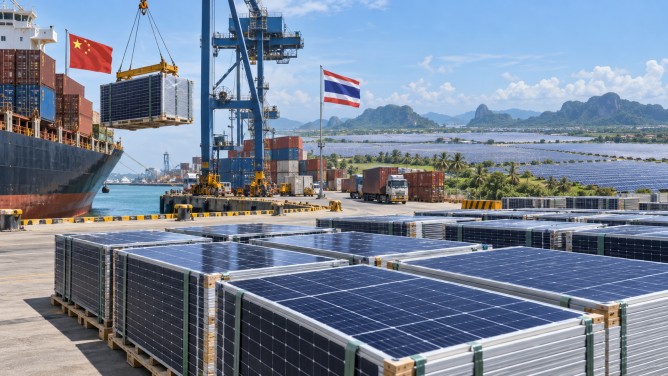
As Thailand intensifies its focus on renewable energy, solar panel imports have seen a dramatic increase, reflecting the country’s commitment to expanding its clean energy infrastructure. According to recent data from Thailand’s Ministry of Commerce and Customs Department, the nation’s solar panel imports soared by 88.7% to reach $426.7 million in the first seven months of 2026. This surge is primarily driven by imports from China, which alone accounted for 99.3% of the total value.
China’s contribution to Thailand’s solar panel imports stood at $423.9 million, marking an impressive 107.1% rise compared to the same period in the previous year. In contrast, other suppliers like Singapore and Hong Kong played a much smaller role, each contributing around 0.3% of the total import value.
The significant rise in imports aligns with Thailand’s upcoming household solar installation program, which aims to provide financial support for solar adoption. The government is preparing to offer subsidies of approximately THB50,000 per household, initially targeting one million homes with potential plans to expand to 1.5 million. This initiative is expected to encourage both rooftop and ground-mounted solar installations, ultimately reducing household electricity costs and fostering a domestic clean-energy supply chain.
In addition to the subsidy program, the Thai government is exploring strategies to bolster its domestic solar manufacturing capabilities. Efforts are underway to collaborate with the Ministry of Labour to develop training programs for workers in solar panel assembly, installation, and maintenance. Concurrently, discussions with the Board of Investment focus on reducing duties for production inputs that are not available domestically, further incentivizing local manufacturing.
These comprehensive measures reflect Thailand’s strategic push towards renewable energy and its aspiration to become a leader in clean energy within the region. By enhancing both the supply and demand sides of the solar market, Thailand aims to build a sustainable energy future that supports economic growth and environmental stewardship.