
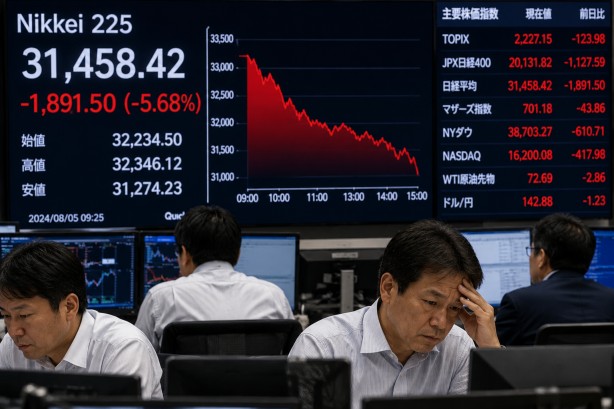
Asian stock markets experienced a significant downturn on Friday, with Japan’s Nikkei 225 index suffering a notable drop. The index plummeted by 5.8%, closing beneath the 63,000 threshold, largely due to substantial sell-offs in the technology and artificial intelligence sectors, which unsettled investors. Taiwan’s stock market mirrored this decline with losses exceeding 5%, while Hong Kong’s Hang Seng index decreased by 2%, and China’s Shanghai Composite saw a 1.6% reduction. Australia’s S&P/ASX 200 index also fell, albeit more modestly, by 0.7%.
In recent weeks, technology stocks have come under increasing pressure as concerns mount over the rapid escalation of valuations within the artificial intelligence industry. Investors are beginning to question the sustainability of high demand for advanced chips and memory products, especially if artificial intelligence does not yield the anticipated profits and gains in productivity. Such apprehensions have added to the volatility in the market.
In the U.S., the Nasdaq Composite index experienced a 1.5% decline on Thursday, driven by notable losses among major chipmakers. Nvidia’s shares fell by 2.4%, while other significant players like Micron Technology, SanDisk, and Western Digital also recorded substantial decreases. This trend highlights the broader uncertainty and pressure affecting technology stocks globally.
Amid these developments in the stock market, oil prices saw an uptick due to escalating tensions in the Middle East. Concerns are rising over potential disruptions to global energy supplies, particularly through the critical Strait of Hormuz. Brent crude oil prices increased by 1.1%, reaching $85.13 per barrel, while the U.S. benchmark crude climbed by 1.3%, hitting $79.95 per barrel.